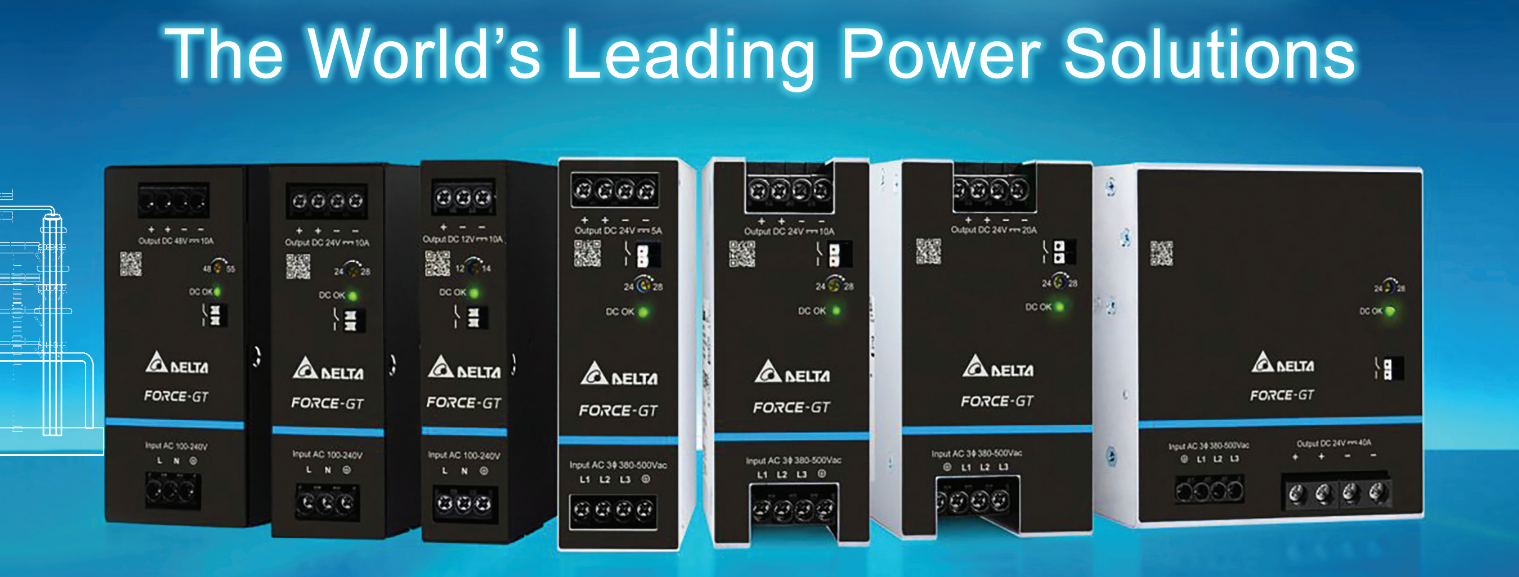
When it comes to industrial automation, the demand for compact, energy-efficient, and high-performing DIN rail power supplies is greater than ever. As control panels get smaller and system designs become more complex, every millimetre of space counts—without sacrificing reliability or output.
Delta's DIN rail power supplies are globally trusted for their durability, efficiency, and reliable performance in high-demand industrial environments.
Applications
-
Factory automation panels
-
Machine control systems
-
Building automation
-
Industrial power distribution boards
Why Choose Delta DIN Rail Power Supplies?
Delta's power supplies are designed with industry-leading technology, offering:
-
Ultra-slim, space-saving form factor
Minimise panel space requirements while maximising performance. -
High power density & superior efficiency
Achieve up to 90% efficiency at 230VAC, reducing operational costs and panel heat. -
Stable power output for critical industrial processes
Ensuring reliable power delivery even in challenging environments.
Delta Industrial DIN Rail Power Supplies Models and Specifications
| Model | Output Voltage | Current | Phase | Mounting Type |
|---|---|---|---|---|
| LYTE II | 12V / 24V / 48V DC | 1.6A – 20A | Single-Phase | DIN Rail |
| FORCE-GT (Single) | 12V / 24V DC | 5A – 20A | Single-Phase | DIN Rail |
| FORCE-GT (Three) | 24V DC | 5A – 20A | Three-Phase | DIN Rail |
| CHROME II | 5V / 12V / 24V DC | 1.5A – 4.5A | Single-Phase | DIN Rail |
| DC-UPS (DRU Series) | 24V DC | 10A – 40A | DC Input | DIN Rail |
| Redundancy (DRR) | 22–60V DC | 20A / 40A | DC Input | DIN Rail |
| Buffer (DRB) | 24V DC | 20A | DC Input | DIN Rail |
Introducing the FORCE-GT Series – Engineered for Demanding Applications
The FORCE-GT Series is Delta’s latest innovation in the DIN rail power supply range. Available in both single-phase and three-phase models, it is designed to tackle next-generation automation challenges with:
-
Superior thermal performance for heavy-duty applications.
-
Flexible installation options for easy integration.
-
Robust, durable construction built to withstand harsh industrial conditions.
Key Benefits of Delta DIN Rail Power Supplies
✔ Compact ultra-slim design for tight panel spaces
✔ High-efficiency operation reduces energy consumption
✔ Stable and reliable power output
✔ Flexible mounting options
✔ Durable and rugged build quality
Smarter Power Solutions for Industrial Automation
Delta continues to lead the market with innovative power supply solutions that go beyond expectations. With a focus on efficiency, reliability, and compact design, Delta’s DIN rail power supplies are the ideal choice for manufacturers looking to streamline operations and reduce operational costs.
For more information click Delta DIN Rail Power Supplies
Contact Us for Product Enquiries
Looking for a reliable DIN rail power supply solution?
Get in touch with Mechtric today for expert advice and competitive pricing on Delta’s power supply range.
Phone: 1800 252 995
Email: